
When you are comparing access control companies in Kansas City, the right partner is a locally established installer that designs, installs, and services electronic entry systems (key fobs, mobile credentials, keypads, and cloud-managed door controllers) and can back the work with monitoring and ongoing support. For businesses across the Kansas City metro and nearby Lee’s Summit, that usually means choosing a provider who understands local building stock, integrates access control with your cameras and alarms, and does not disappear after the install.
Key takeaways
- Look for integration, not just locks. The best access control ties into video surveillance and intrusion detection so one event tells a complete story.
- Cloud-based systems let Kansas City and Lee’s Summit managers lock doors, add users, and pull entry logs from a phone.
- Local matters. A company familiar with metro construction, winter freeze-thaw, and multi-site retail along US-50 and I-470 will spec hardware that survives the conditions.
- Ask about service response, not just price. A door controller that fails on a 10-degree January morning needs a tech who can get there.
- Plan for growth. Scalable credentials and controllers save money when you add doors or locations later.
What access control companies actually do
Access control replaces mechanical keys with managed electronic credentials. Instead of rekeying a lock when an employee leaves, you deactivate their badge or mobile credential in seconds. A full-service provider handles the design (how many doors, which entry points, what credential type), the installation (controllers, readers, electric strikes or maglocks, and wiring), and the management software that logs every entry and exit. The best access control systems treat all of that as one package rather than a box of parts you are left to configure yourself.
Good installers also help you think through the trade-offs. Proximity fobs are inexpensive and familiar but easy to share or lose. Mobile credentials on a smartphone are harder to clone and cut down on plastic, but they depend on staff carrying charged phones. PIN keypads are cheap but codes get passed around. A practitioner will usually recommend a mix based on how each door is used.
Why local Kansas City knowledge matters

A system designed for a mild coastal climate will not hold up here. The Kansas City area sees real temperature swings, and Lee’s Summit businesses deal with the same freeze-thaw cycles that stress exterior door hardware, gaskets, and outdoor readers through winter. Electric strikes and maglocks on exterior doors should be rated and installed with weather in mind, and a local installer knows which components tend to fail after a few Missouri winters.
Local building stock matters too. Lee’s Summit’s mix of newer commercial construction along Chipman Road and NE Douglas, older downtown storefronts near the historic district, and warehouse and flex space toward the I-470 and US-50 corridors each call for different mounting, wiring, and controller placement. A company that works the metro regularly has seen all of it. For a sense of how coverage scales with a property, our guide on how many cameras your Kansas City business needs walks through the same site-by-site thinking.
How to choose among access control companies
Price is the easiest thing to compare and the least useful on its own. Weigh these instead:
- Integration: Can the system share events with your cameras and alarms? When a forced-door alarm pulls up the matching video clip automatically, investigations take minutes instead of hours.
- Remote management: Cloud platforms let you manage multiple Lee’s Summit or metro sites from one dashboard.
- Service and response time: Ask where their techs are based and what their realistic response window is for a dead door.
- Scalability: Confirm you can add doors, sites, and users without replacing the core hardware.
- Licensing and insurance: Low-voltage and alarm work can carry licensing requirements, so confirm a company’s credentials and consult a licensed professional on anything compliance-related.
It also helps to understand the technology before you buy. Our explainer on how an access control system works covers the parts and the signal flow. If you are weighing cloud versus on-premise, read up on cloud-based security systems and what they mean for day-to-day management. Many Lee’s Summit operators land on cloud-based security systems precisely because they run several locations and want one login that controls every door, rather than driving between sites to reprogram a local panel.
Integrating access control with cameras and alarms

The real value shows up when systems talk to each other. Pairing access control systems with video means every badge swipe and every denied entry can be matched to footage. Add intrusion detection and a single after-hours door event can trigger an alert, a recording, and a verified response. According to the FBI Uniform Crime Reporting Program, property crime remains one of the most commonly reported offense categories nationally, which is why layered, verifiable systems beat a standalone lock.
For Lee’s Summit employers, the same integration supports everyday operations: time-stamped entry logs for shift accountability, temporary credentials for contractors, and the ability to lock down a building instantly from a phone. The U.S. Small Business Administration’s guidance on protecting a small business emphasizes building security into operations rather than bolting it on after an incident.
What a typical install looks like
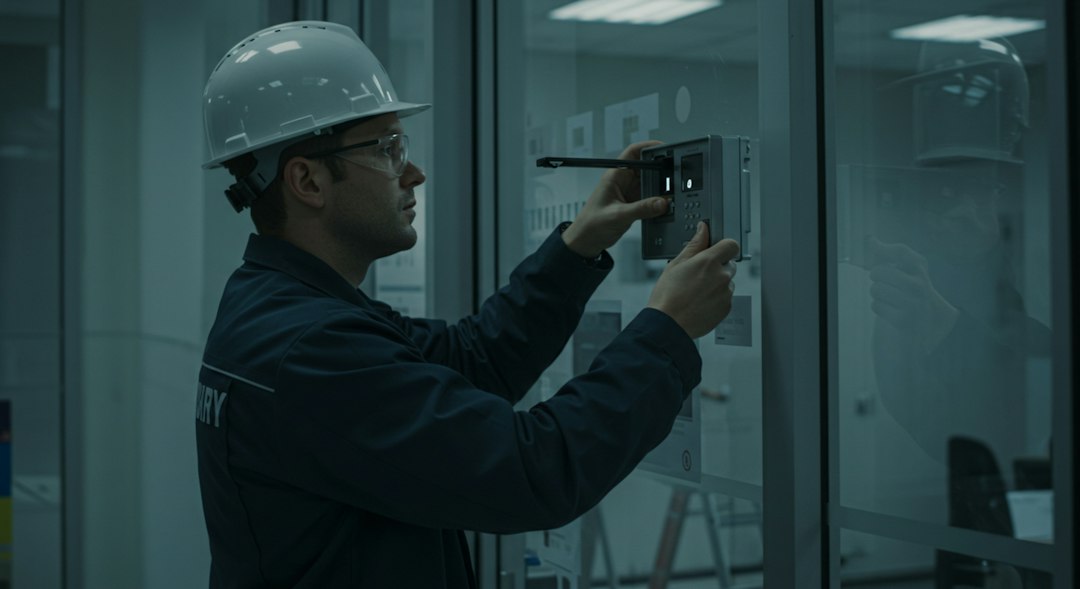
For a small-to-midsize Lee’s Summit business, expect a site walk first, where the installer identifies entry points, existing door hardware, network drops, and power. A standard two-to-four-door project often takes one to a few days depending on wiring runs and whether cores and strikes need replacing. Cloud-managed systems come online quickly once controllers are networked, and user enrollment can happen the same day.
Budget-wise, costs scale with the number of doors, credential type, and whether you want integrated video and monitoring. The honest trade-off: spending a bit more up front on scalable controllers almost always costs less than ripping out an undersized system a year later. When you are ready to scope a project, a provider can give you a tailored quote after a walkthrough, or you can reach out directly to talk through your sites.